DFA Data Collection and Accountability — Round 3 and Round 2

Dance/USA Fellowships to Artists (also known as DFA) is a national dance fellowship program that offers direct support to individual artists who have developed a sustained and intentional practice of working through dance and movement-based modalities to address social change. 

Beginning in Round Two, as part of DFA’s responsive program design, the program team built internal systems of accountability to support the application review process and to challenge implicit biases. For Rounds 2 and 3, demographic information was gathered through the submission forms, and each applicant was able to self-identify around gender/sex, race/ethnicity, artistic form/genre, and disability*.

*Disability is not represented in the below charts as we did not request applicants to name their specific impairment, so disability identification is binary.

Round 3 Data Collection and Accessibility

Written and collected by Michèle Steinwald

In Round Three of the program (2025-2026), 25 fellows were awarded a $31,000 award to be used at the artist’s discretion. DFA’s values align with artists whose social change practices reflect the national dance ecosystem’s rich and wide-ranging perspectives.
 
DFA collects applicant demographic data in an open field format. From the 589 applications received for DFA Round 3, the data collected resulted in:
  • 592 unique names for dance and movement forms, genres, and disciplines, equaling 2,525 mentions with an average of 4.3 disciplines per application,
  • 129 unique identities for race and ethnicity, totaling 644 mentions, and
  • 76 unique identities for gender and sex, with 546 mentions.
  •  

To interpret the trends and patterns within this demographic information, we collaborated with graphic designer Gene Pendon to create the charts shared below.

Please note, all these charts are meant to be read as intersectional; applicants often chose multiple words to describe their identities and practices.

Gender and Sex Data

 
The chart for gender and sex is organized as a spectrum according to three main categories: non-binary (nested circles on top), female (nested circles on left), and male (nested circles on right). In Round 3, the applicants listed specific terms and descriptors that created more precise gradation from trans through to cis. Moreover, there were ethnically specific terms that are grouped together as an emergent category and centered within the Venn diagram. While the gender-expansive non-binary section and gender-expansive male section are of similar scale (108 and 123 mentions respectively), the gender-expansive female section has 313 mentions and is in reality over twice their volume in scale.
Image description in caption.
Image description: A complex, overlapping Venn-style diagram titled “Gender + Sex.” Multiple intersecting circles contain dozens of gender- and sex-related identity terms, showing overlap rather than fixed categories. Large clusters include “woman/womanish” (301 mentions), “man” and “male-identifying,” “he/him/his” (109 mentions), and “she/her/hers.” Other circles list identities such as non-binary, genderqueer, gender fluid, trans, transgender, cisgender, agender, and queer, with smaller counts noted in parentheses. At the center intersection are culturally specific identities—“black,” “māhū,” “mātāo,” “tāgaiya,” and “two-spirit” (7 mentions). The overall layout emphasizes fluidity, overlap, and multiplicity in gender and sex identification rather than a binary structure.

Credit info: Gender/Sex mentions from Round 3 applicant pool
Data visualization chart created by Gene Pendon (design) and Michèle Steinwald (data).

Download a PDF of this chart.

Race and Ethnicity Data

 
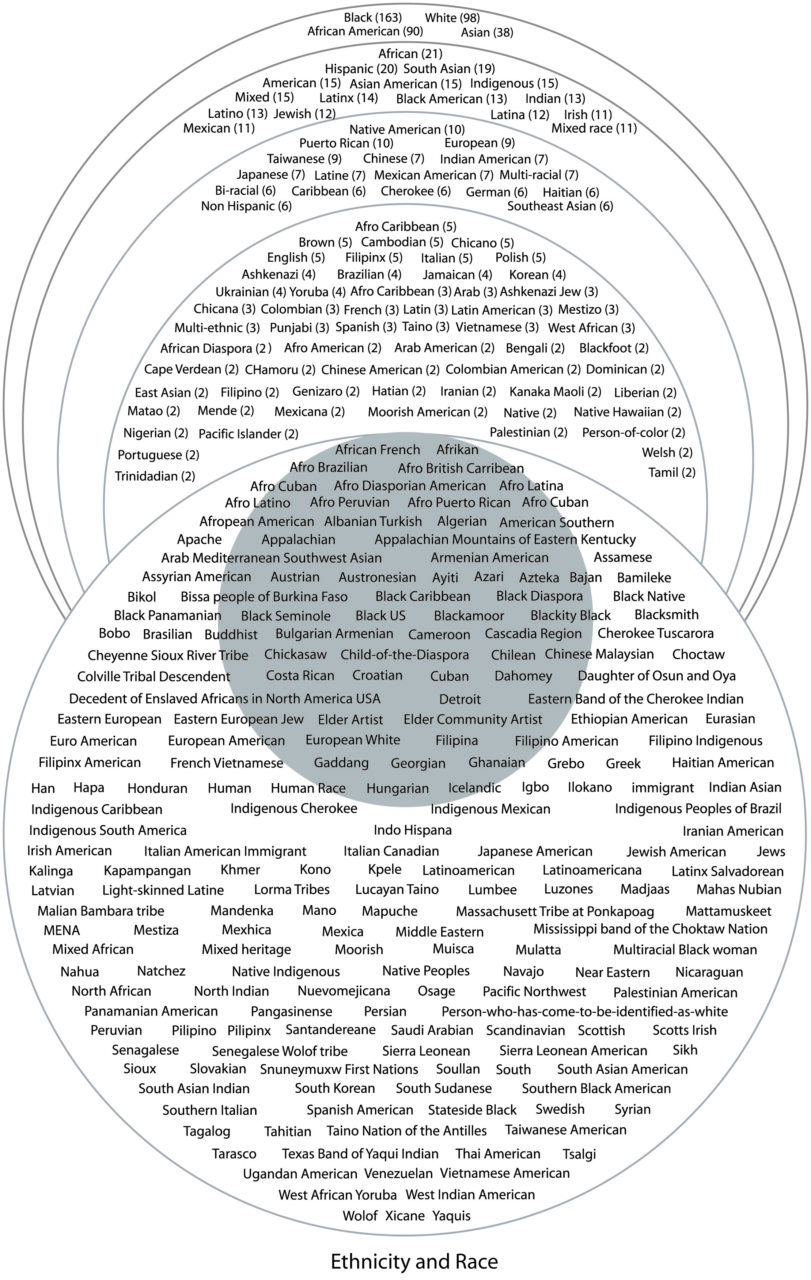
The chart groups the data by number of mentions. The largest numbers of mentions are in the larger outer circles. The lower the number of mentions, the more data points are listed, and the more space visually is needed. The single-entry data points are magnified at the core of the nested circles, with a shaded area marking where the circle would normally be positioned in the overall diagram.
Image description in caption.
Image description: A dense, multi-ring diagram titled “Ethnicity and Race.” Concentric and overlapping oval shapes contain a large number of racial, ethnic, cultural, and national identity terms, emphasizing breadth and overlap rather than fixed categories. The outer rings list higher-frequency identities such as “Black” (163 mentions), “White” (98), “African American” (90), “Asian” (38), and “American,” with counts shown in parentheses. Inner rings include increasingly specific identities—such as Latinx, Indigenous, Asian American, Afro Caribbean, Jewish, Native American, and multiracial categories—followed by hundreds of more granular identities naming diasporas, tribes, regions, nationalities, and cultural affiliations. A darker central cluster highlights overlapping, complex identities related to African, Afro-diasporic, Indigenous, immigrant, and mixed heritage experiences. The overall layout visually conveys race and ethnicity as expansive, layered, and interconnected rather than singular or binary.

Credit info: Race/Ethnicity mentions from Round 3 applicant pool
Data visualization chart created by Gene Pendon (design) and Michèle Steinwald (data).

Download a PDF of this chart.

Dance Form and Discipline Data

 
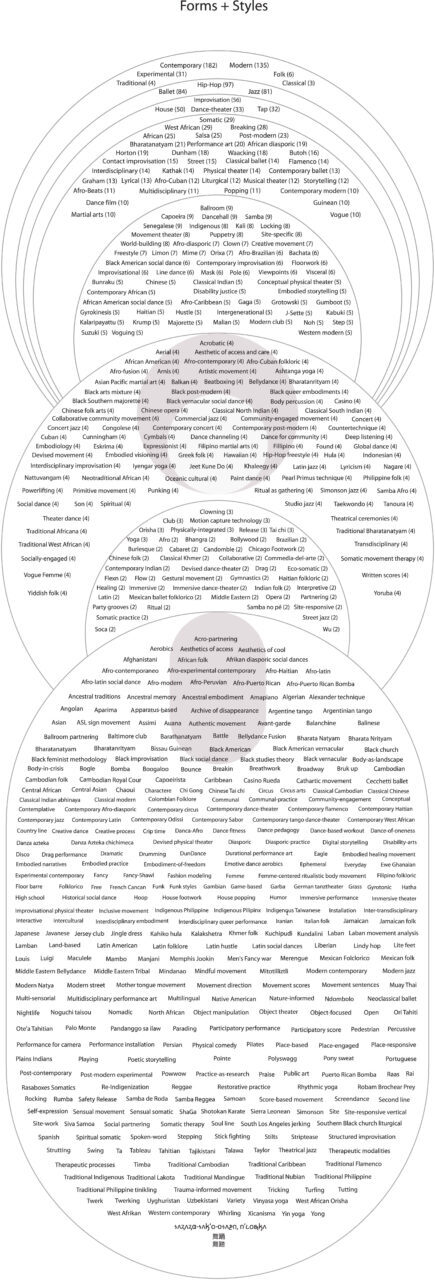
For the most part, the chart groups dance forms and disciplines by number of mentions. The greatest numbers of mentions are the outer circles—except for the top circle which groups together a ‘super structure’. Applicants often listed the terms within the super structure (i.e. traditional, contemporary, experimental, classical, folk, and modern) as adjectives, but sometimes as nouns. While not always the greatest number of mentions, these terms have the potential to radically alter the form (i.e., contemporary Indian dance vs classical Indian dance), and because of their power, the super structure sits at the top of the diagram in a position of great influence.
 
Similar to the data chart from Round 2, this one foregrounds the diversity within the applicant pool by listing all the unique-mentioned terms as the base. Due to the volume, these densely grouped sections are magnified for legibility and the shaded areas mark where the shape would have rested within the chart.
 
Image description in caption.
Image description: A large, densely populated, multi-ring diagram titled “Forms + Styles.” Concentric arcs list hundreds of dance, movement, and performance forms, organized by frequency and overlap rather than strict categories. The outer rings highlight high-frequency forms such as Contemporary (182 mentions), Modern (135), Hip-Hop (97), Ballet (84), Jazz (81), Improvisation, House, and Dance-theater, with counts shown in parentheses. Moving inward, the diagram includes increasingly specific practices spanning global, cultural, and interdisciplinary forms—such as West African, Bharatanatyam, Afro-diasporic styles, somatics, breaking, tap, salsa, voguing, capoeira, clowning, ritual, martial arts, disability justice–informed practices, and experimental performance. The central, darker cluster emphasizes overlapping and hybrid approaches, including Afro-partnering, African diasporic social dances, experimental and contemporary hybrids, and aesthetics-based frameworks. The overall composition visually conveys dance and movement as expansive, interconnected, culturally rooted, and non-hierarchical rather than a fixed taxonomy.

Credit info: Dance Form/Discipline mentions from Round 3 applicant pool
Data visualization chart created by Gene Pendon (design) and Michèle Steinwald (data).

Download a PDF of this chart.

Round 2 Data Collection and Accessibility

Written and collected by Michèle Steinwald

In Round Two of the program (2021-2023), 30 fellows were awarded a $30,000+ award that was used at the artist’s discretion. DFA’s values align with artists whose social change practices reflect the national dance ecosystem’s rich and wide-ranging perspectives.
 
From the 413 applications received for DFA Round Two, the data collected resulted in:
  • 383 unique names for dance and movement forms, genres, and disciplines, equaling 1,558 mentions with an average of 3 to 4 forms/genres per application,
  • 246 unique identities for race and ethnicity, totaling 775 mentions,
  • 25 unique identities for gender and sex, with 429 mentions.

To amplify the trends and patterns within this demographic information, we collaborated with graphic designer Gene Pendon to create the charts shared below.

Please note, all these charts are meant to be read as intersectional and as multiplicitous; applicants often chose multiple words to describe their identities and practices. 

Gender and Sex Data

 
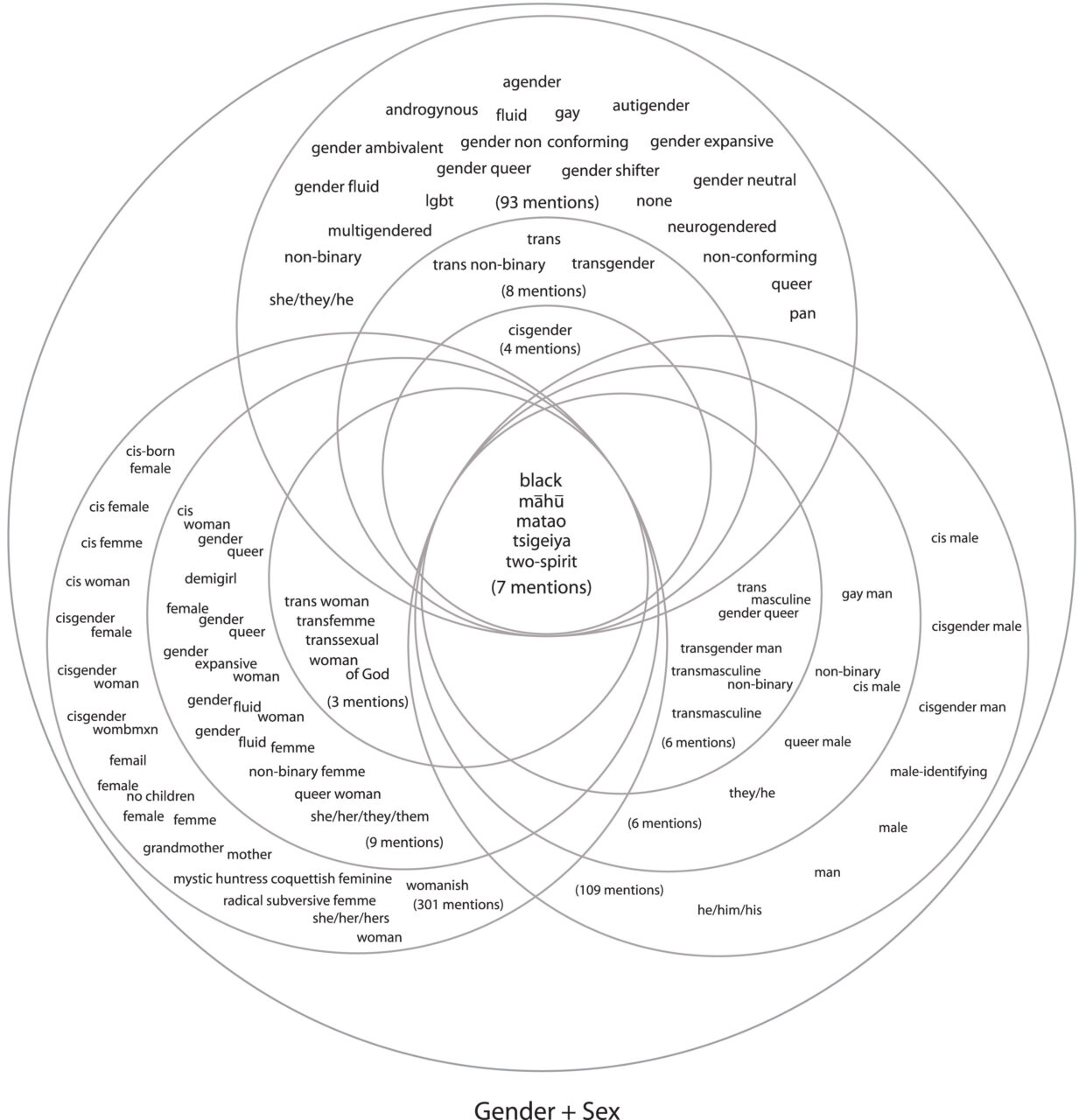
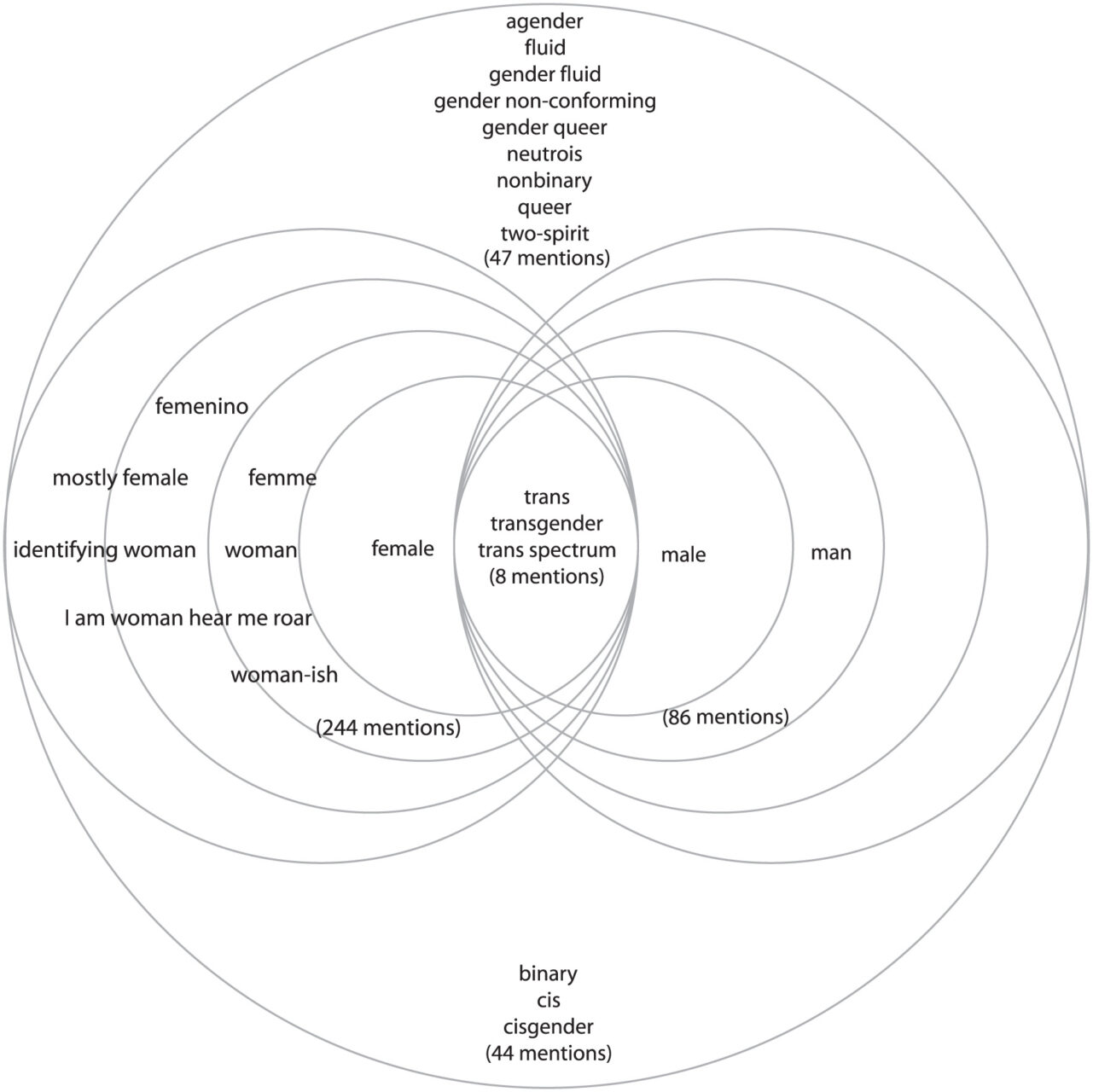
The chart focuses on undoing any binaries or unintentional centering of heteronormative structures and instead illustrates multiplicity as many of the applicants chose multiple words to identify their gender. Moreover, each term was pulled apart, and their mentions listed separately (e.g., when counting trans male in one response alongside trans nonbinary, two mentions for trans were listed and one mention for male and one for nonbinary). These groupings are meant to be intersectional and each term expansive, therefore dismantling any restrictive or patriarchal definition.
ID in caption

Two sets of overlapping concentric circles with “female”, “femme”, “woman” (mostly female, femenino, identifying woman, I am woman hear me roar, woman-ish) representing one side with 244 mentions and “male” and “man” representing the other with 86 mentions. The overlapping middle represents terms “trans”, “transgender” and “trans spectrum” with 8 mentions. Above but outside the overlapping circles are words agender, fluid, gender-fluid, gender nonconforming, genderqueer, neutrois, nonbinary, queer, and two-spirit (47 mentions). Below and outside the circles are binary, cis, cisgender (44 mentions). Credit info: Gender/Sex mentions from original applicant pool (Round two) Data visualization chart created by Gene Pendon (design) and Michèle Steinwald (data).

Download a PDF of this chart.

Race and Ethnicity Data

 
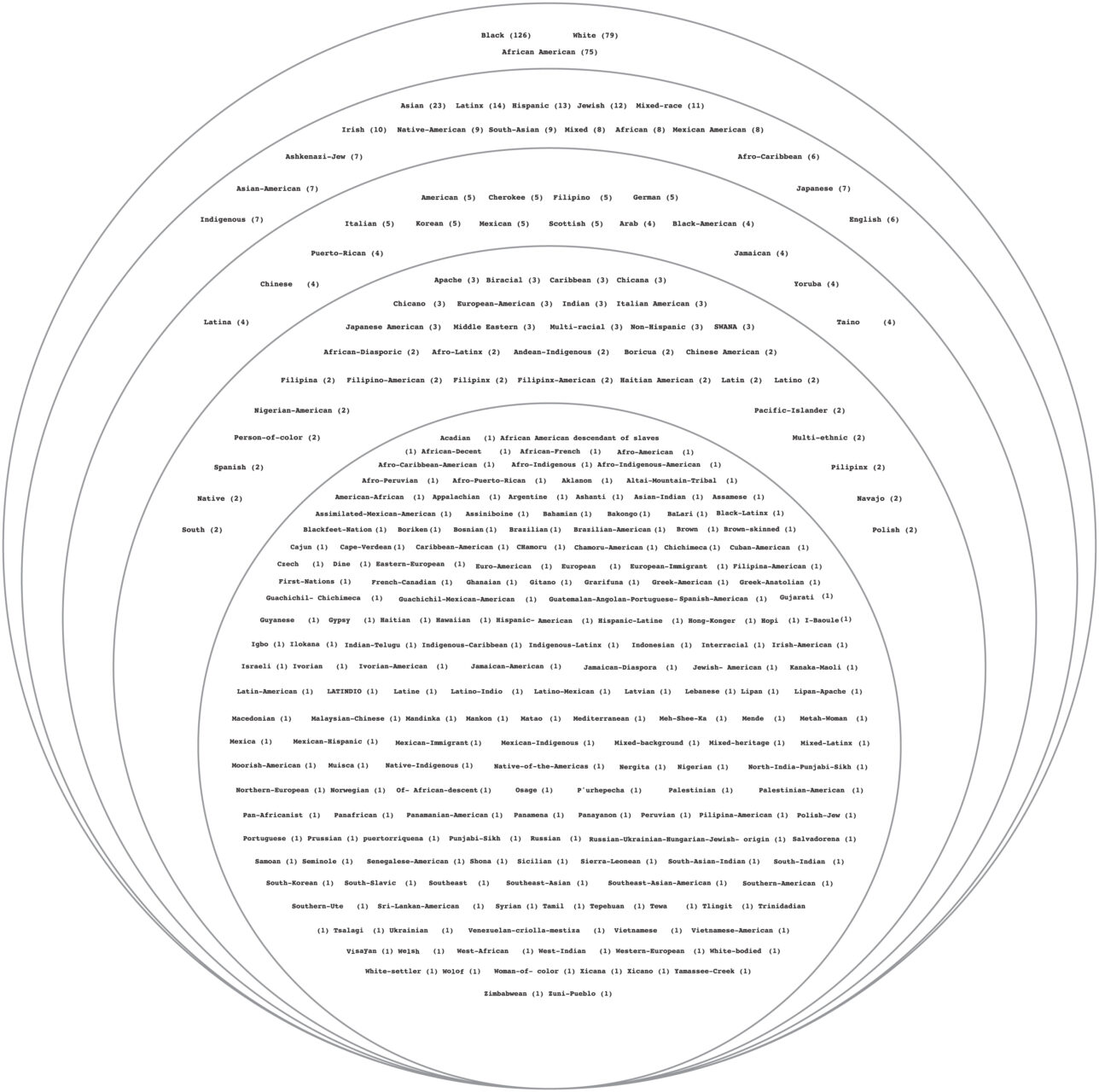
The chart foregrounds the smallest numbers of mentions as they show the greatest amount of diversity within the applicant pool. The higher numbers of mentions contain and encompass larger cultural communities. These larger circles surround the smaller inner circles to never lose the solitary individual mentions as the visual core of the chart. All the circles combine gravitationally onto one balancing point at the bottom, linking the circles. (Please note that to avoid antiquated language, the term caucasian was eliminated and mentions instead counted towards the term white.)
ID in caption

A chart of 246 race and ethnicities, layered in five concentric circles. Text that represents a race/ethnicity is coupled with a number representing the number of times this race/ethnicity is mentioned in the application forms. The outmost layers represent the highest-number mentions (Black, white, and African-American), the inner-most circle represents race/ethnicities only mentioned once. Credit info: Race/Ethnicity mentions from original applicant pool (Round two). Data visualization chart created by Gene Pendon (design) and Michèle Steinwald (data). Please contact the program team for the full text list of terms.

Download a PDF of this chart.

Dance Form and Genre Data

Similar visual structure as the race/ethnicity chart (i.e., higher mentions surround smaller circles of mentions which are the focal point), however the top circle holds a “super structure” with the terms traditional, contemporary, and modern, which applicants sometimes used as adjectives and sometimes as nouns. The terms within the super structure are not always the highest number of mentions as they have the potential to qualify a form, and in doing so, change the form dramatically (i.e., traditional African dance vs contemporary African dance). Applicants didn’t specify ratios to these terms so, for instance, various forms of dance may appear in their practice without one central form as the foundation or reversely one form mentioned may be primary to their practice while other mentions are merely meant as supporting methodologies and additional influences.
ID in caption

A chart of over 383 dance genres, forms, and techniques, layered in six concentric circles. Text that represents a dance genre is coupled with a number representing the number of times this genre is mentioned in the application forms. The outmost layers represent genres with the highest-number mentions, except for the largest circle which represents the terms that are used as either nouns or adjectives. The inner-most circle represents genre/forms only mentioned once. Credit info: Dance form/genre mentions from original applicant pool (Round two) Data visualization chart created by Gene Pendon (design) and Michèle Steinwald (data).

Download a PDF of this chart.

In Summary

In centering the most impacted, principles of social justice were applied in practice throughout the program. By tracking demographics as an accountability tool, the DFA program team was able to build a review process that reflected the ratios and specific diversity found in the applicant pool. The data reinforced the process of addressing equity and systemic biases embedded in culture at large.

The owner of this website has made a commitment to accessibility and inclusion, please report any problems that you encounter using the contact form on this website. This site uses the WP ADA Compliance Check plugin to enhance accessibility.
Dance/USA
Privacy Overview

This website uses cookies so that we can provide you with the best user experience possible. Cookie information is stored in your browser and performs functions such as recognising you when you return to our website and helping our team to understand which sections of the website you find most interesting and useful.