
DFA Data Collection and Accountability — Round 3 and Round 2
Dance/USA Fellowships to Artists (also known as DFA) is a national dance fellowship program that offers direct support to individual artists who have developed a sustained and intentional practice of working through dance and movement-based modalities to address social change.
Beginning in Round Two, as part of DFA’s responsive program design, the program team built internal systems of accountability to support the application review process and to challenge implicit biases. For Rounds 2 and 3, demographic information was gathered through the submission forms, and each applicant was able to self-identify around gender/sex, race/ethnicity, artistic form/genre, and disability*.
*Disability is not represented in the below charts as we did not request applicants to name their specific impairment, so disability identification is binary.
Round 3 Data Collection and Accessibility
Written and collected by Michèle Steinwald
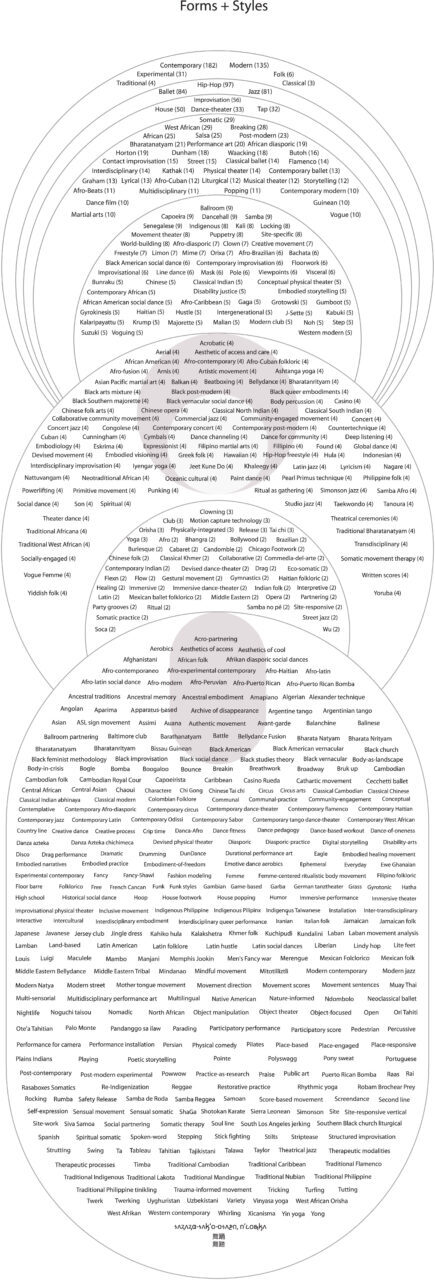
- 592 unique names for dance and movement forms, genres, and disciplines, equaling 2,525 mentions with an average of 4.3 disciplines per application,
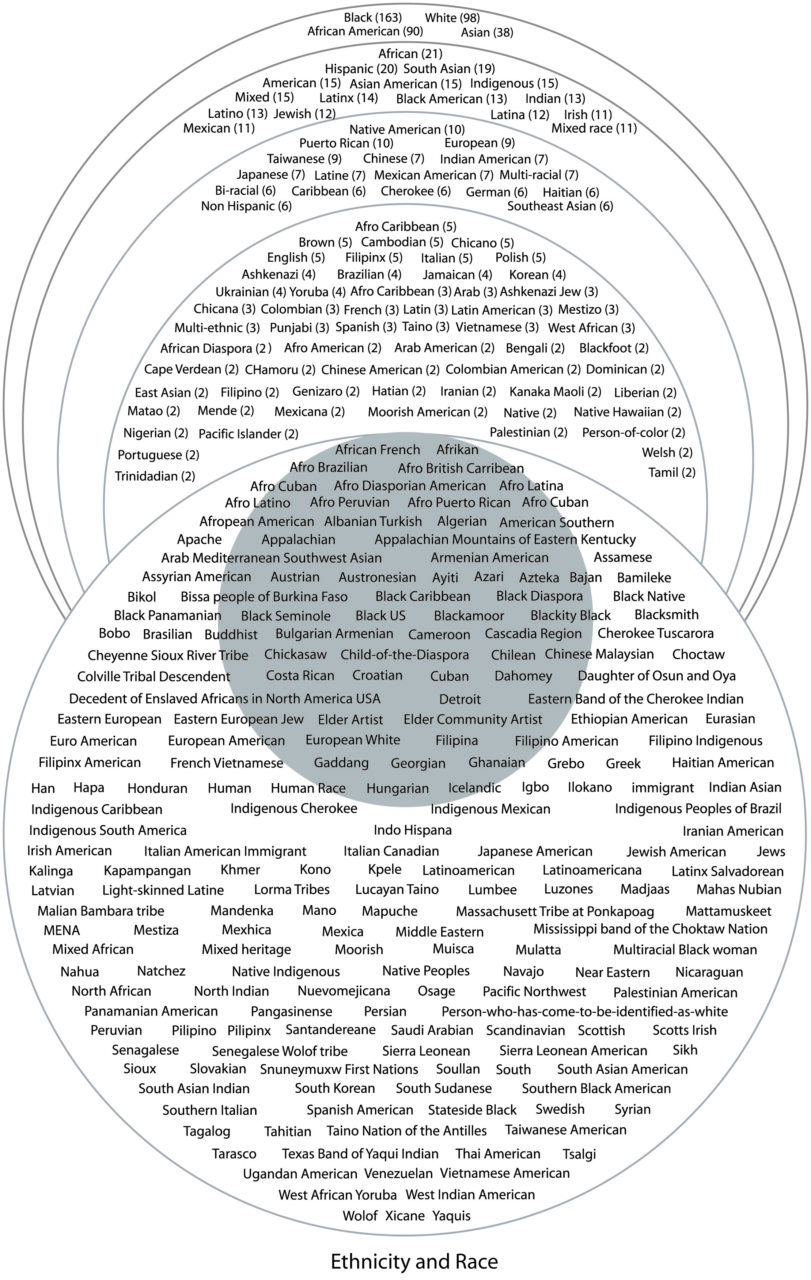
- 129 unique identities for race and ethnicity, totaling 644 mentions, and
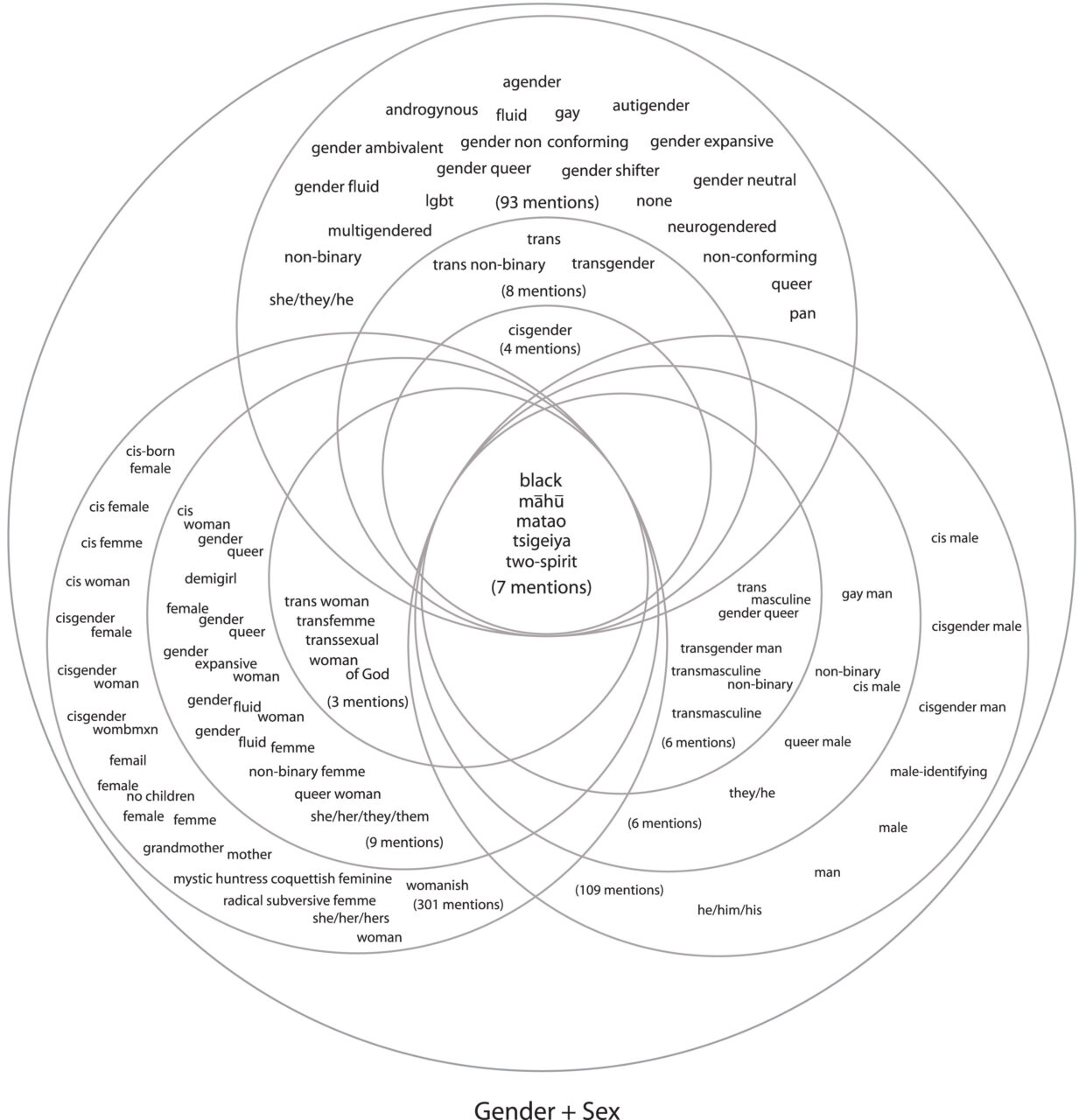
- 76 unique identities for gender and sex, with 546 mentions.
To interpret the trends and patterns within this demographic information, we collaborated with graphic designer Gene Pendon to create the charts shared below.
Please note, all these charts are meant to be read as intersectional; applicants often chose multiple words to describe their identities and practices.
Gender and Sex Data
Credit info: Gender/Sex mentions from Round 3 applicant pool
Data visualization chart created by Gene Pendon (design) and Michèle Steinwald (data).
Race and Ethnicity Data
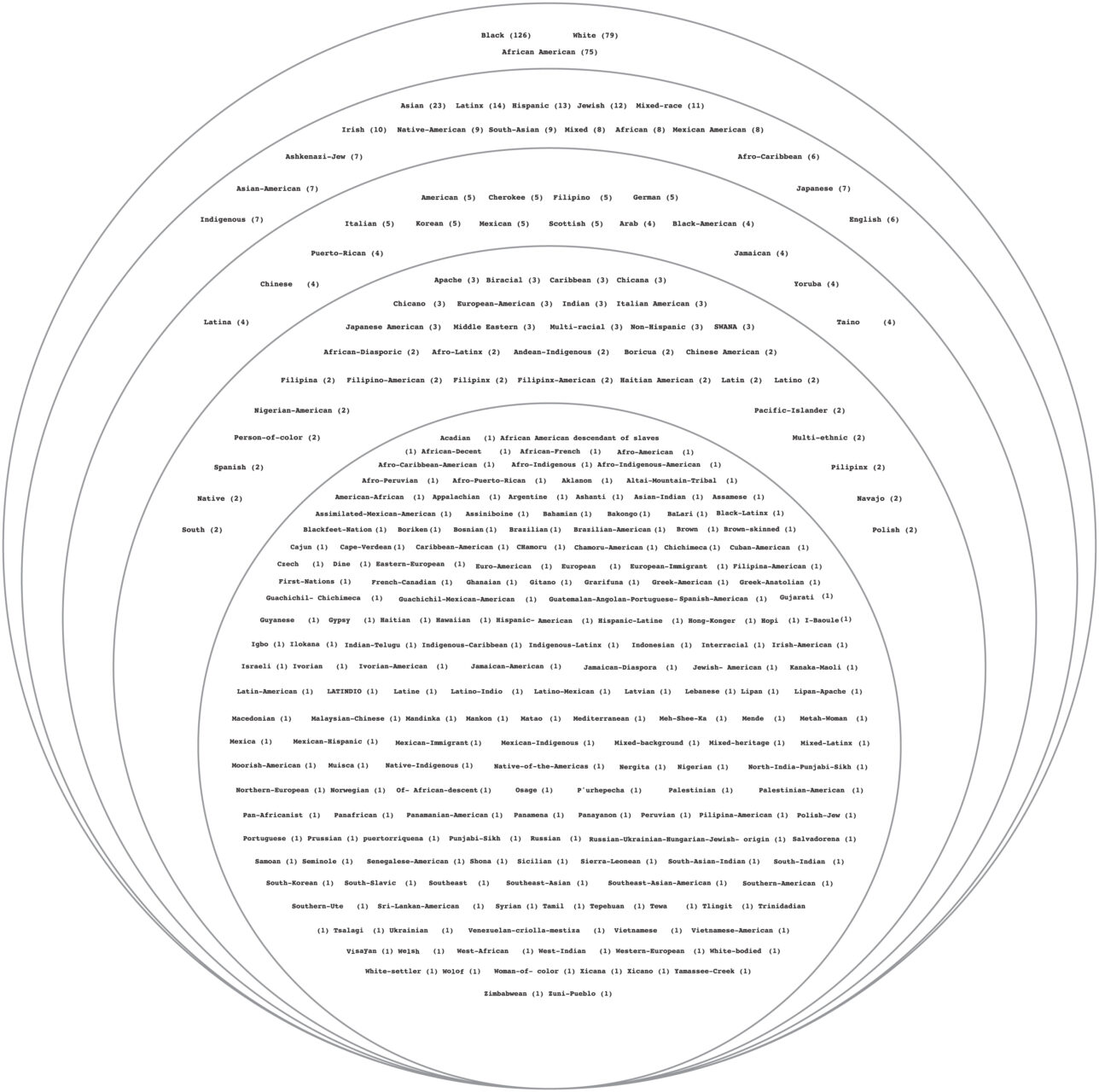
Credit info: Race/Ethnicity mentions from Round 3 applicant pool
Data visualization chart created by Gene Pendon (design) and Michèle Steinwald (data).
Dance Form and Discipline Data
Credit info: Dance Form/Discipline mentions from Round 3 applicant pool
Data visualization chart created by Gene Pendon (design) and Michèle Steinwald (data).
Round 2 Data Collection and Accessibility
Written and collected by Michèle Steinwald
- 383 unique names for dance and movement forms, genres, and disciplines, equaling 1,558 mentions with an average of 3 to 4 forms/genres per application,
- 246 unique identities for race and ethnicity, totaling 775 mentions,
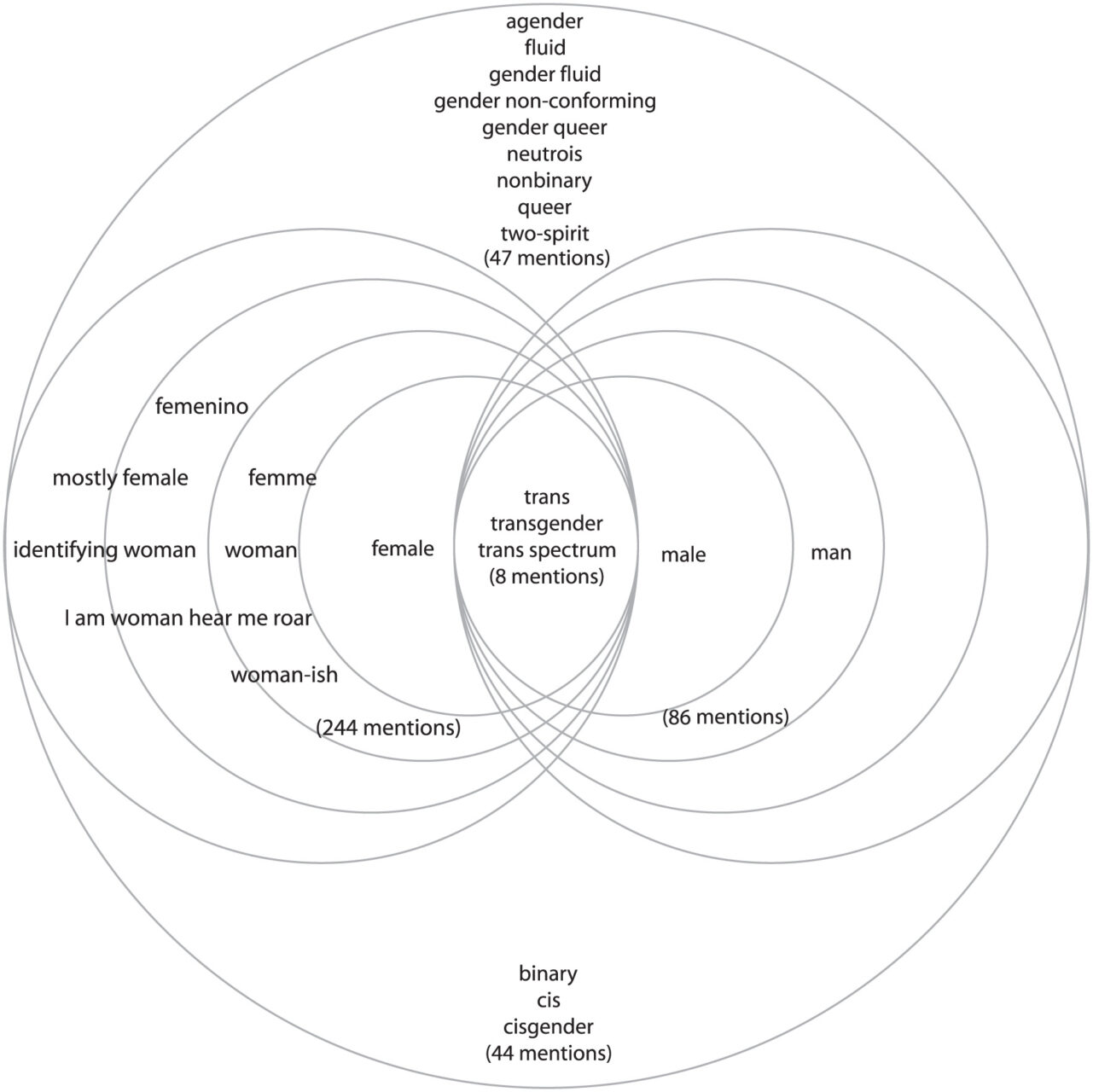
- 25 unique identities for gender and sex, with 429 mentions.
To amplify the trends and patterns within this demographic information, we collaborated with graphic designer Gene Pendon to create the charts shared below.
Please note, all these charts are meant to be read as intersectional and as multiplicitous; applicants often chose multiple words to describe their identities and practices.
Gender and Sex Data

Two sets of overlapping concentric circles with “female”, “femme”, “woman” (mostly female, femenino, identifying woman, I am woman hear me roar, woman-ish) representing one side with 244 mentions and “male” and “man” representing the other with 86 mentions. The overlapping middle represents terms “trans”, “transgender” and “trans spectrum” with 8 mentions. Above but outside the overlapping circles are words agender, fluid, gender-fluid, gender nonconforming, genderqueer, neutrois, nonbinary, queer, and two-spirit (47 mentions). Below and outside the circles are binary, cis, cisgender (44 mentions). Credit info: Gender/Sex mentions from original applicant pool (Round two) Data visualization chart created by Gene Pendon (design) and Michèle Steinwald (data).
Race and Ethnicity Data

A chart of 246 race and ethnicities, layered in five concentric circles. Text that represents a race/ethnicity is coupled with a number representing the number of times this race/ethnicity is mentioned in the application forms. The outmost layers represent the highest-number mentions (Black, white, and African-American), the inner-most circle represents race/ethnicities only mentioned once. Credit info: Race/Ethnicity mentions from original applicant pool (Round two). Data visualization chart created by Gene Pendon (design) and Michèle Steinwald (data). Please contact the program team for the full text list of terms.
Dance Form and Genre Data

A chart of over 383 dance genres, forms, and techniques, layered in six concentric circles. Text that represents a dance genre is coupled with a number representing the number of times this genre is mentioned in the application forms. The outmost layers represent genres with the highest-number mentions, except for the largest circle which represents the terms that are used as either nouns or adjectives. The inner-most circle represents genre/forms only mentioned once. Credit info: Dance form/genre mentions from original applicant pool (Round two) Data visualization chart created by Gene Pendon (design) and Michèle Steinwald (data).
In Summary
In centering the most impacted, principles of social justice were applied in practice throughout the program. By tracking demographics as an accountability tool, the DFA program team was able to build a review process that reflected the ratios and specific diversity found in the applicant pool. The data reinforced the process of addressing equity and systemic biases embedded in culture at large.
